Aligning Expertise with Content Marketing to Fulfill and Serve Audience Demand
By Lance Lunsford, MBA, FACHE
Groundswell Health
WHAT MATTERS
- AI Search – or Generative Search Optimization – is a milestone in the history of the Internet, and its DNA is rooted in how Google started and evolved to meet people’s desire for more information … faster.
- Keywords in Search Engine Optimization are still critical and play a major role in how your organization’s AI Search Optimization works.
- Leaders must expect trust optimization, demanding more from their communications teams to mine their organizations’ subject matter expertise and systemically convey it to their target audiences authentically and specifically.
For years, healthcare organizations treated search engine optimization like a technical exercise that frequently neglected strength of content and context for target audiences. Add enough keywords. Publish enough blogs. Hire someone to optimize metadata. Repeat. In a radical change, optimization for AI search, is uniquely situating organizations that prioritize integrity, authenticity, specificity, and best-in-class services. At a time when trust and confidence in healthcare institutions and professionals have waned, these changes in search optimization are welcome.
Google recently released details on how it plans to maintain its core business around Search while adopting AI into its engine to meet user demand, confirming that Google is still made up of really high IQ staff who are charged with protecting its revenue.
The early days of Google were built on the idea that mere frequency of keywords on a website deemed the site an authority on that topic. Things changed quickly. As web content managers caught on, they built sites with white text and blank pages just to rank higher. Illicit websites emerged, bringing audiences to questionable content using the frequency tactic. Google made corrections that depended on what the Yellow Pages had figured out long before: Legitimacy usually aligns with financials. That is to say, ”Those with the funds to pay for listings over competitors are much more likely to be legitimate.” The Search Engine Optimization and Search Engine Marketing industry was born from that competitive clamor and businesses’ willingness to pay for audiences searching for services like theirs. As businesses grew concerned about losing ground to emerging players, a cottage industry of marketers emerged that built its value proposition around best practices in SEO rather than a holistic content strategy designed to service audiences with empowering information.
Brands are still focused largely on keywords, but, that sole tactic no longer works. Your communications team probably knows that part, but what comes next – and in which order – is a bit more complex.
The rise of generative AI in search — whether through Google AI Overviews, ChatGPT, Perplexity, or emerging healthcare-specific discovery tools — is fundamentally reshaping how organizations are found online. For hospitals, health systems, physician groups, and enterprise healthcare companies, trying to regain trust in a post-truth environment, the implications of the transition to AI searches are even more profound.
In many ways, however, this moment is inspiring. The future of discoverability will not belong to organizations producing the most content. It won’t necessarily be won by the team who applies their SEO tools to include the most keywords.
It will belong to organizations producing the most credible, authentic, and specific content that delivers expertise. Knowledge. Actionable information. Communications professionals must work more collaboratively with their internal subject matter experts to ensure audiences hear from the most credible sources. This credibility does not come from machines. It comes from earned authority.
Shifting Rules in Online Searches
In the early days of content management and writing for the web, I encouraged clients and my teams to treat site visitors as people looking to learn in the same way they would approach a textbook. No one goes out looking for ways to become a marketing target. We don’t yearn for advertising to be sold something. We want information that helps us make a good decision.
Treating web content as a place where audiences can learn means depending on your team’s most trusted authorities on subject matter. It’s up to the communications team to make it cohesive, engaging, and interesting. Do that, and it becomes informative. The resulting reputation from constantly strengthening your trust metrics in your respective community
Recent updates to Google’s guidance for AI-powered search reveal an important truth: generative search engines are not simply surfacing whoever publishes the most articles. Instead, they are prioritizing sources that demonstrate:
- Expertise
- First-hand experience
- Trusted authority
- Original perspective
- Proven credibility
Real-world knowledge matters again. Google’s AI systems increasingly summarize information from sources already considered trustworthy and authoritative in traditional search. If your organization lacks demonstrable expertise, differentiated thinking, or evidence of experience, AI engines are unlikely to prioritize your voice. That means healthcare organizations relying on generic, AI-generated blogs are entering dangerous territory. If your content sounds like everyone else’s, AI may summarize your facts — but skip presenting your organization to potential customers entirely.
Healthcare Cannot Afford “Commodity Content”
Healthcare is not retail. It is not consumer gadgets. It is certainly not a category where generic content builds trust. Healthcare decisions involve human lives, clinical complexity, regulatory oversight, financial risk, and a wealth of highlytrained medical insight. Patients, physicians, policymakers, board members, and community stakeholders expect expertise. Yet much of the healthcare content online today reads the same:
- “5 Tips for Better Population Health”
- “Why Telehealth Matters”
- “How Hospitals Can Improve Patient Experience”
The problem is that much of it could have been written in 10 seconds by a large language model. AI search engines are increasingly learning to recognize the pattern. The future belongs to what some industry observers now call “un-AI-able” content — content that reflects actual experience, shares proprietary insight, delivers operational knowledge, and provides nuanced perspective.
For healthcare organizations, this means content must increasingly reflect real operational expertise. Healthcare communication cannot exist in a vacuum. The strongest content comes from professionals who understand:
- Hospital operations
- Reimbursement pressures
- Commercial payer operations
- Workforce shortages
- Community trust challenges
- Regulatory demand
- The very crowded information…and misinformation healthcare space
When content reflects operational understanding, it naturally becomes more credible — both to people and to AI systems evaluating authority.
Real Policy Fluency
Healthcare is one of the most policy-driven industries in America. Organizations publishing shallow content disconnected from reimbursement trends, regulatory policy, state and federal legislation, payer expectations, or compliance realities will increasingly struggle to establish authority.
AI content prioritization systems reward specificity. They reward expertise. They reward context.
Generic talking points are fading away, and your communications team will struggle to build trust and reputation without drilling for depth that thrills and engages your audiences and builds real trust.
Real Communications Experience
In healthcare, messaging is rarely theoretical. A specificity is required where people are looking for the kind of proven insights that heal, save lives, and improve health. At minimum, they’re looking for ways to feel better. Internally, there’s a mechanism for value and depth as well. This is a natural outgrowth of an industry reminding itself that its mission-critical principle is to do no harm. As a result, healthcare moves slowly and intentionally to be observant of the entire market where it is impacted by:
- Hospital closures
- Workforce shortages
- Political scrutiny and opportunism
- Community distrust
- State and federal regulatory mandates
- Customer service crises
The organizations best positioned for the future of search are those creating content informed by communicators who have actually navigated these realities with their internal experts while also building up their own knowledge bases from original source material and experts. Audiences might be moved by a podcaster speaking of the next great threat from chemtrails to gamma rays loose in nature (probably spoken through a swollen fat lip stuffed full of tobacco snuff). But when they’re more aware of trusted sources, they’re more likely over the long-term to invite a trusted nurse or physician to do a cross-examination of the promises of a too-good-to-be-true elixir made from beef tallow, the swollen tongue of a Coconut Crab found only in the remote islands of the Indo-Pacific, cod liver oil, and crushed Flintstones vitamins.
Why AI Alone Is Not the Answer
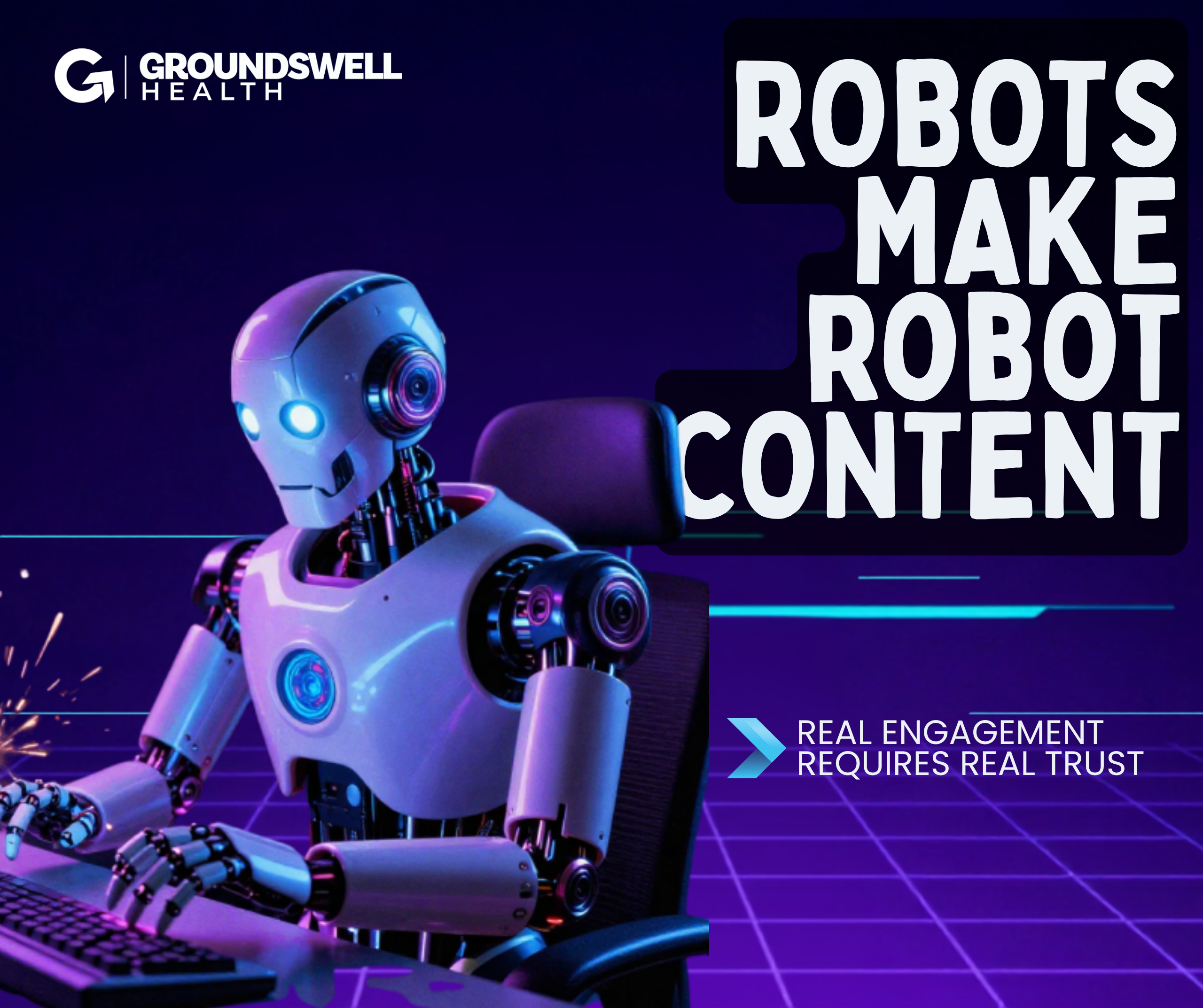
Let’s be clear: AI can be an extraordinary productivity tool. At Groundswell Health, we believe strongly in a careful use of AI to accelerate workflows, automate where advisable, and improve efficiency where possible.
However, AI can only support expertise. It can’t replace it or recreate it. A machine can summarize information. It might organize language. It can mimic tone.
What it cannot do is replicate:
- Years of healthcare communications experience
- Operational understanding of hospitals and health systems
- First-hand public affairs experience
- Crisis communications judgment
- Deep policy interpretation
- Community stakeholder insight
- Understanding of complex human behavior
Without experienced humans guiding strategy, AI-generated content often becomes what Google increasingly filters out: Commodity content.
The New Currency of Search Is Trust
For healthcare organizations, SEO is no longer just search engine optimization. Leaders have to build for trust optimization. The organizations that will win in AI search over the next decade are the ones that become known for original thinking and unique ways to convey the internal working knowledge and expertise of their physicians, nurses, and administrators. Communications teams will have to work to offer perspectives others are not providing.
- Real Experience: Publishing insights informed by actual operational work and presented in a way the helps audiences feel as though they’re accumulating knowledge and learning.
- Human Expertise: Featuring physicians, operators, executives, and subject-matter experts.
- Consistent Credibility: Building a body of work people — and AI systems — recognize as dependable and trustworthy.
- Reputation Beyond Your Website: Trust increasingly comes from signals outside your owned channels. This includes earned media, speaking engagements, industry citations, peer validation, community partnerships, and authentic stakeholder engagement.
Healthcare organizations should stop asking, “How much content do we need?” Rather, they should be asking, “What authority are we demonstrating?” In an AI-powered future, on-line discoverability will increasingly favor organizations that can answer hard questions with real expertise, requiring communications teams to hone their healthcare knowledge beyond marketing buzzwords.
At Groundswell Health, we believe trust is built through informed strategy — shaped by professionals with deep experience in healthcare operations, public affairs, policy, communications, and stakeholder engagement. The future of healthcare visibility will not be won by whoever publishes the most content. It will be won by whoever earns the most trust, and as trust emerges from confidence in authority, conveying it to an audience still requires people with a dedication and interest to doing good work with acumen and skill.
Read more


Medicare Advantage Headlines >>
Why Medicare Advantage Plans are Losing More Providers
Medicare Advantage plans’ excessive denials, restrictive provider networks, and contentious contract negotiations continue to increase the number of health systems
Medicare Advantage Has Become Notorious for Prior Authorization Burden
Medicare Advantage plans denied 7.4 percent of medical professionals’ prior authorization requests, or about 3.4 million requests, according to a